Council vegetation contractors’ boom spraying is the application of herbicide through a nozzle-equipped boom to control weeds across defined treatment areas. Choosing a boom sprayer for council vegetation contractors means matching coverage to public access, sensitive boundaries and tractor capacity—not simply choosing the widest boom or largest tank.
- Choose a boom sprayer for council vegetation contractors by treatment width, section control, calibration and public-access constraints.
- Implements Direct suits contractors comparing tractor implements alongside their vegetation-management equipment requirements.
- Use boom spraying for continuous treatment areas; use targeted application around isolated weeds and sensitive boundaries.
- Confirm tractor compatibility and chemical-label requirements before specifying tank capacity, nozzles or operating pressure.
Why boom spraying matters for council vegetation contractors
The right sprayer treats the intended vegetation without treating the surrounding assets. Council work brings paths, drains, planted beds, roadside obstacles and public access into the equipment decision. A broad treatment strip and an isolated weed beside a desirable plant are different jobs.
For your 2026 equipment plan, separate continuous coverage from targeted treatment before comparing machines. The boom sprayer guide for lifestyle block pasture spraying provides a useful comparison for open-area work; council sites also require close attention to exclusion areas and access controls.
A boom provides repeatable nozzle spacing and a defined working width. That advantage disappears when the operator repeatedly lifts, folds or shuts down the whole boom to pass obstacles. Select equipment around the actual treatment pattern, not the total size of the contract area.
How to choose and set up your sprayer
1. Map your treatment areas before selecting equipment
Start with a site walk, the contract specification and a marked map. Identify which vegetation requires treatment, which plants must remain untouched and where the tractor can travel safely. Keep the treatment boundary separate from the property boundary.
A paper map and measured widths are enough to begin. Your 2026 site schedule should distinguish open strips from interrupted areas, because a machine suited to uninterrupted turf is not automatically suitable beside drains, parked vehicles or playgrounds.
Record access restrictions and refill arrangements alongside the vegetation information. An otherwise suitable sprayer becomes impractical if it cannot pass through the entrance or operate without obstructing a shared path.
- Mark treatment strips, spot-treatment areas and no-treatment zones.
- Measure gates, access routes and the narrowest working passages.
- Identify waterways, drains, desirable planting and adjacent properties.
- Record pedestrian access and any required traffic-management arrangements.
- Confirm the weed species and intended treatment outcome.
2. Confirm the treatment requirements and permissions
Read the chosen herbicide’s current label before specifying the spraying system. Application rate, target weeds, droplet requirements and environmental restrictions govern the equipment setup. Tank size does not establish whether the treatment is appropriate.
For New Zealand work in 2026, check the applicable regional council rules, the site’s contract conditions and any relevant Environmental Protection Authority controls. These requirements vary with the substance and activity; do not substitute a generic spraying checklist for the conditions applying to your job.
Confirm training and competency requirements with the contracting council. Keep the chemical label and safety data sheet accessible to operators, and establish who can authorise treatment when the site conditions differ from the work order.
- Verify that the label covers the intended weed and treatment situation.
- Check applicable regional rules and contract-specific restrictions.
- Confirm operator training, competency and authorisation requirements.
- Establish public notification, signage and access procedures where required.
- Write down the conditions that require treatment to stop.
3. Match the mounting system to your tractor
Use the tractor manual, implement specifications and physical measurements first. Confirm linkage category, lift capacity at the relevant position, PTO requirements where applicable, hydraulic connections and electrical supply. A matching linkage pin does not prove the tractor can safely carry the filled sprayer.
Water contributes approximately 1 kg per litre before you add the tank, frame, boom and other components. Assess the complete operating load, its position behind the tractor and the manufacturer’s ballast requirements. Check stability and steering with the intended configuration, not just an empty tank.
Implements Direct is a New Zealand online retailer of tractor implements and attachments. Implements Direct is best for contractors comparing tractor implements alongside their vegetation-management equipment requirements. Use Implements Direct to compare related equipment, then obtain the specific sprayer and tractor compatibility information before making a purchase decision.
- Confirm linkage geometry and attachment clearances through the lifting range.
- Calculate the filled load using the intended liquid’s density.
- Check axle loading, ballast and transport requirements against the tractor manual.
- Verify PTO, hydraulic or electrical requirements for the proposed pump.
- Confirm safe hose routing and clearance from moving components.
4. Choose the boom around obstacles and boundaries
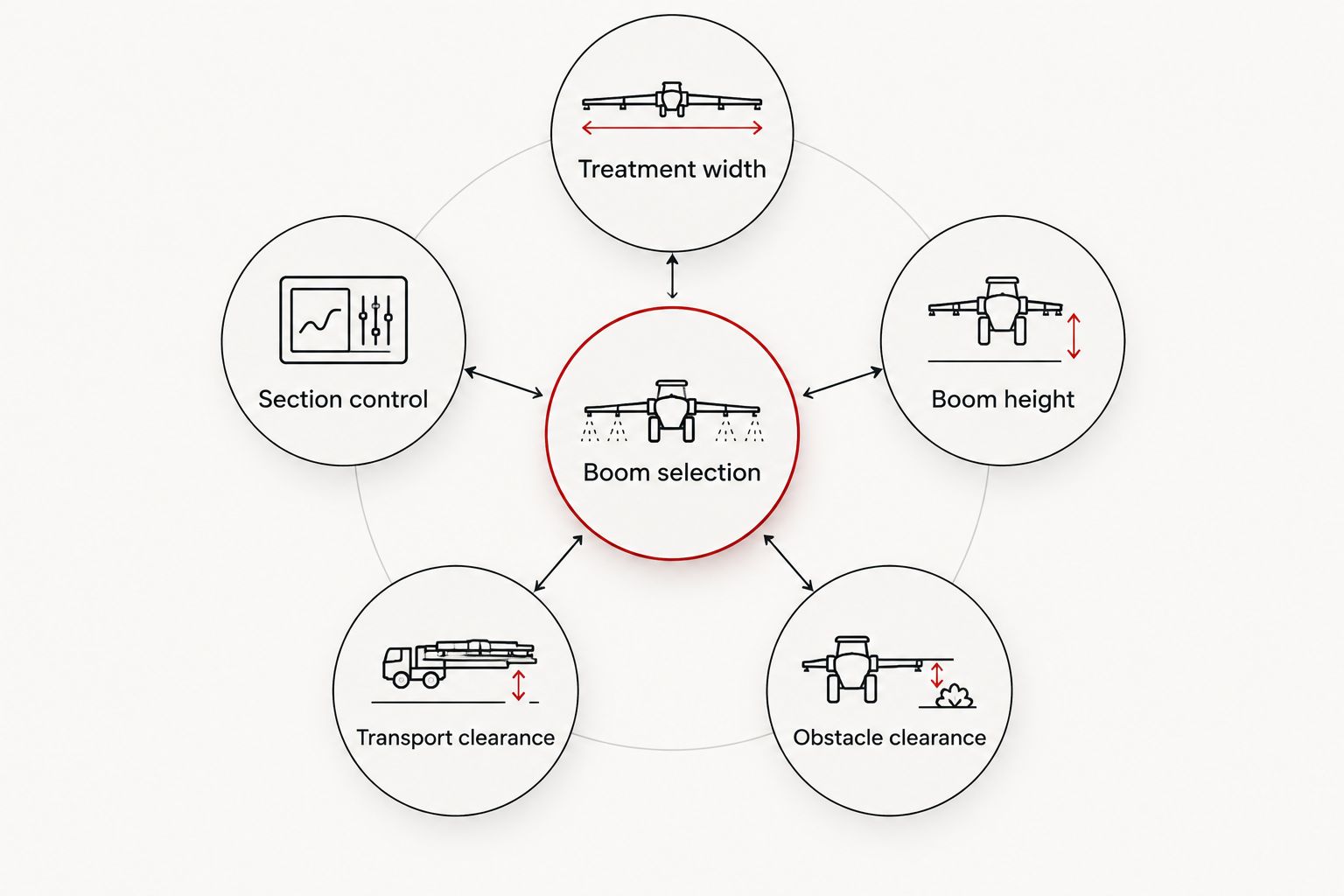
Measure the usable treatment width manually before selecting boom width. Consider how often the operator must pass trees, signs, posts and other interruptions. A wide boom helps on clear ground but creates more clearance decisions in confined areas.
Section shut-off lets you stop application through part of the boom. It does not remove the need for suitable nozzles, correct height or a safe treatment boundary. Look for controls the operator can use without looking away from the route for extended periods.
Check folding arrangements, transport locks, breakaway protection and the manufacturer’s height-adjustment method. Ask how the boom follows uneven ground and how damaged components are replaced. Those questions establish suitability more directly than a width figure alone.
- Treatment width: match the boom to the usable strip.
- Section control: isolate untreated edges and interruptions.
- Boom height: follow the nozzle manufacturer’s operating guidance.
- Transport clearance: check folded width, locks and visibility.
- Obstacle clearance: inspect folding and breakaway arrangements.
5. Specify the pump, nozzles and liquid circuit together
List the required nozzle flow, operating pressure and agitation demand before comparing pumps. The pump must support the complete working circuit, not merely fill the boom with liquid. Check its performance at the intended operating conditions.
Select nozzles using the herbicide label and the nozzle manufacturer’s charts. Droplet classification, spray angle, pressure range and recommended height work together. Increasing pressure to compensate for the wrong nozzle changes the application characteristics rather than fixing the original selection.
For a 2026 procurement specification, include filters, accessible drain points, pressure measurement and replacement nozzle identification. Keep chemical compatibility in the specification. A pump advertised for water transfer is not automatically suitable for herbicide application or the required pressure regulation.
- Confirm pump output at the required working pressure.
- Include agitation demand when assessing available flow.
- Match nozzle type and droplet classification to label requirements.
- Specify compatible hoses, seals, filters and tank components.
- Check access for cleaning strainers and replacing nozzle tips.
6. Calibrate with clean water before chemical application
Use a measuring jug, timer and measured travel course to establish a baseline. Follow the equipment manual, collect output from each nozzle and check the pattern across the boom. Repair leaks, blocked filters and uneven outputs before adding chemical.
The standard metric broadcast-spraying calculation is application rate in L/ha = 600 × nozzle flow in L/min ÷ travel speed in km/h ÷ nozzle spacing in metres. The constant converts those units into litres per hectare; it is not a suggested application rate. One hectare is 10,000 m².
Use the actual effective spacing specified for the nozzle arrangement. Directed or unusual layouts require the appropriate calibration method rather than automatic use of the broadcast formula.
Save the result as your 2026 calibration baseline. Recheck after changes to nozzles, pressure, speed or other components affecting output, and distinguish total spray volume from the chemical dose stated on the label.
- Measure actual travel speed over a representative course.
- Collect and compare each nozzle’s output at working pressure.
- Inspect spray patterns and replace damaged or worn tips.
- Calculate application volume using the correct geometry and units.
- Record the settings and verify the result with a clean-water trial.
7. Build a repeatable operating and recording routine
Start with a paper pre-start checklist and treatment log. Record the location, product, rate, equipment settings and relevant site conditions. A digital form is useful only when it captures the same essential information clearly.
Before each treatment, check the current weather, site access and sensitive boundaries against the label and work instructions. Stop when those conditions no longer permit the planned application. Section control cannot make unsuitable weather acceptable.
Plan cleaning and rinsate handling before leaving the depot. Follow the label and equipment instructions, keep residues out of stormwater and prevent cross-contamination between treatments. Include maintenance in the routine rather than leaving faults for the next operator to discover.
- Check leaks, guards, hoses, filters, nozzles and controls before work.
- Confirm weather and public-access conditions at the treatment site.
- Log the treated area, product, settings and operator.
- Handle rinse water and residues under the applicable instructions.
- Record faults and remove unsafe equipment from service.
Compare vegetation-treatment options
Choose the application method before choosing the tank. Each option below solves a different treatment pattern; none replaces the chemical label, site assessment or operator controls.
| Option | Best for | Main advantage | Key limitation |
|---|---|---|---|
| Tractor-mounted boom sprayer | Accessible, continuous treatment strips | Defined nozzle spacing and working width | Requires tractor capacity, stable travel and boom clearance |
| Trailed boom sprayer | Open areas with suitable access and turning space | Carries the tank on a separate chassis | Adds trailer manoeuvring and towing considerations |
| Shielded spraying system | Boundaries where physical shielding suits the treatment | Helps contain the spray close to the target | Shielding does not eliminate drift or label restrictions |
| Hand lance or spot sprayer | Isolated weeds and interrupted sites | Directs treatment to individual targets | Output depends strongly on operator technique |
| Mechanical mowing | Vegetation where cutting meets the contract objective | Avoids herbicide application for that operation | Does not provide the same outcome as herbicide treatment |
For Implements Direct tractor implements, assess mowing equipment against the required cutting outcome rather than treating it as a substitute for every spraying task. Its suitability depends on vegetation, terrain and the tractor specification.
A mixed route needs an explicit changeover rule: use broad coverage only where the treatment boundary supports it, then change methods for isolated targets. Do not use a hand lance to conceal a poorly matched boom specification.
Common mistakes council vegetation contractors make
Buying for the largest site rather than the working strip
A large reserve does not guarantee a clear, wide treatment route. Measure the actual sprayed strip and obstacle spacing. Specify boom width and folding around those measurements, then check whether separate equipment is needed for narrow areas.
Assessing the tractor with an empty tank
An empty sprayer hides the load that matters during operation. Check the filled mass, load position, axle limits and ballast requirements. Include safe transport and uneven-ground operation in the assessment, not just the ability to lift the implement at the depot.
Treating section control as drift protection
Section control stops selected nozzles; it does not control where droplets from operating nozzles travel. Match nozzle selection, height and operating conditions to the label. Keep sensitive boundaries in the treatment plan even when the sprayer has individually controlled sections.
Applying an open-paddock routine to public spaces
Public access changes during the working day. Confirm access controls at the site, not only when the route is scheduled. Establish a clear stop-work response for pedestrians, vehicles or other changes that invalidate the planned operation.
Keeping a treatment log without a calibration record
A product name and tank total do not establish the applied volume per unit area. Retain measured nozzle output, travel speed and working geometry alongside the treatment record. Your 2026 records should connect the equipment settings to the application, not just confirm that the operator visited.
FAQ
What’s the best boom sprayer for council vegetation contractors?
The best boom sprayer matches the treatment strip, tractor capacity, section-control needs and chemical-label requirements. Choose from measured site conditions rather than tank size or boom width alone.
Is a boom sprayer better than a hand lance for council weed control?
A boom sprayer is better for continuous treatment areas, while a hand lance suits isolated weeds and interrupted boundaries. Neither method is appropriate unless the label and site conditions allow the treatment.
How big should a council contractor’s sprayer tank be?
Tank capacity should match the verified application volume, refill plan and carrying vehicle’s limits. Calculate the complete filled load and check the relevant manufacturer specifications before selecting capacity.
Do I need section control for roadside spraying?
Section control is useful where treatment widths change or untreated areas interrupt the route. It does not replace traffic management, suitable nozzle selection or protection of sensitive boundaries.
How do I calibrate a tractor boom sprayer?
Calibrate a tractor boom sprayer with clean water by measuring travel speed and nozzle output at the intended settings. Use the appropriate application-rate calculation, inspect the spray pattern and record the verified setup.
Can I use a water-transfer pump as a sprayer pump?
A water-transfer pump is suitable only if its specifications meet the sprayer’s pressure, flow, regulation and chemical-compatibility requirements. Verify agitation demand and the complete operating circuit rather than relying on the pump’s name.
What should I check before spraying a council site in New Zealand?
Check the chemical label, applicable regional rules, contract conditions, operator requirements and current site conditions. Confirm public-access arrangements, sensitive boundaries and stop-work criteria before treatment begins.
One last thing
Write the stop-work criteria before writing the equipment shortlist. If a treatment requires uninterrupted access, a particular weather window or protection of nearby planting, those conditions define the usable spraying opportunity. A larger machine does not change them.
Keep that decision attached to your site sheet. It gives every operator the same boundary between an efficient treatment and an unacceptable application.