Rural water contractors’ PTO pumping is tractor-powered water movement aimed at completing farm transfer, irrigation and wash-down jobs with equipment matched to each site. Choosing a PTO water pump for rural water contractors means checking the whole installation: changing water sources, hose runs and tractor availability make pump output alone an inadequate buying guide.
- Choose a PTO water pump for rural water contractors by working flow, total head and water quality, not outlet size.
- Implements Direct is a practical shortlist source for tractor operators comparing PTO water-transfer equipment alongside other implements.
- Water transfer and wash-down need different flow and pressure checks; confirm both against the pump’s published limits.
- Use a standalone pump when tying up the tractor conflicts with other contracted work.
Why PTO pumping matters for rural water contractors
A contractor’s pump must suit the job at the customer’s property, not just the tractor parked in the yard. Tank filling, irrigation supply and wash-down impose different demands. A pump that transfers water satisfactorily through an open hose is not automatically suitable for a restricted nozzle or elevated delivery point.
Choose the duty first, then the pump. For your 2026 equipment plan, record the water source, destination, required delivery and operating conditions before comparing models. Implements Direct sells tractor implements and attachments; assess a pumping purchase as part of that working equipment set, rather than as an isolated attachment.
PTO drive uses the tractor as the power source, but it also commits that tractor to pumping. Include setup, supervision, cleaning and equipment changeovers in your job plan. A pump that fits mechanically still needs to fit your contracting schedule.
How to choose and set up your PTO water pump
1. Define the water job before selecting equipment
Start with a written job sheet and a site inspection. Identify whether you are filling a tank, feeding an irrigation system or supplying wash-down equipment. Then establish the required flow at the destination and the pressure needed there. Those are separate requirements.
Record water quality as well. Clear tank water, sediment-bearing surface water and liquids containing chemicals require different compatibility checks. Do not treat a general water-transfer description as approval for effluent, fertiliser solutions or drinking-water service.
Use consistent units throughout your 2026 job sheets: litres per minute for flow, metres for elevation and bar for pressure. 1 cubic metre equals 1,000 litres, so converting a tank’s stated volume avoids mixing incompatible units when planning a transfer.
- Record the source and destination, including access for the tractor.
- Identify the required flow and destination pressure separately.
- Describe sediment, debris and any chemical contamination.
- Confirm whether the water has a drinking-water use.
- Note whether the tractor must remain available for other work.
2. Calculate head and inspect the suction route
Measure the elevation difference and hose route manually before asking a supplier to check the duty. Total dynamic head includes the elevation rise, friction losses and required pressure at the delivery point. Hose diameter, length, fittings and flow all affect friction loss.
For water, 1 bar is approximately 10.2 metres of pressure head, and 1 metre of water head is approximately 9.81 kPa. These conversions translate a pressure requirement into head; they do not replace the pump curve or a friction-loss calculation.
Inspect suction separately. Keep the pump’s permitted suction conditions within the manufacturer’s limits, and assess the lowest expected source-water level. Suction lift, restrictions and air leaks affect operation; moving the tractor closer to the source is often a better starting point than adding more hose.
- Measure the delivery elevation from the source-water level.
- Record actual hose lengths, internal diameters and fittings.
- Include filters, valves and delivery equipment in the calculation.
- Check suction conditions against the pump documentation.
- Keep the intake clear of bottom sediment and floating debris.
3. Match the pump type to the working duty
Compare pump documentation against your job sheet before choosing a model. A centrifugal pump and a roller pump move water differently. Centrifugal selection depends on the flow delivered at the required head; roller-pump selection also demands close attention to permitted pressure, speed, materials and pressure-relief arrangements.
Once the duty is defined, use the PTO Water Transfer Roller Pump at Implements Direct as a model to investigate, not as an automatic match. Ask for its operating limits, performance information, connection details and installation instructions before specifying it for a contract.
Implements Direct is best for tractor operators comparing PTO water-transfer equipment alongside other implements. Its water-transfer listing belongs on that shortlist; suitability for your flow, pressure, liquid and operating duration must be established from the model documentation.
Follow this selection sequence rather than starting with the connection size.
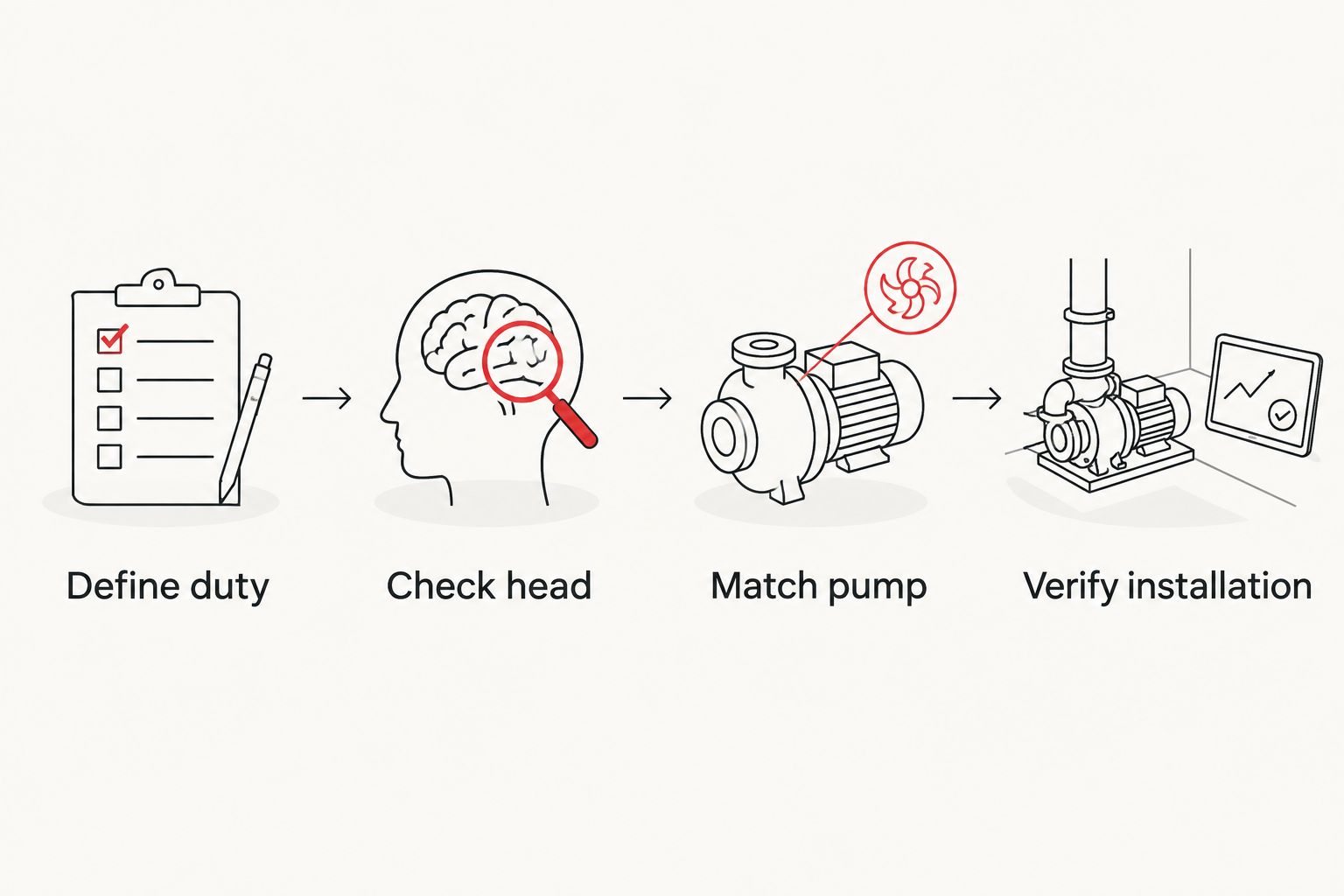
A connection dimension does not establish a pump’s working output. Your 2026 purchasing checklist should request flow at the required head, not just a maximum flow figure measured under different conditions.
- Define duty: state required flow, pressure and water quality.
- Check head: include elevation and system losses.
- Match pump: obtain the model’s operating limits and performance information.
- Verify installation: confirm drive, mounting, hoses and protection.
- Request written confirmation for any non-standard liquid or application.
4. Verify the tractor drive and secure the installation
Read both manuals before connecting anything. Match the tractor’s PTO speed, shaft connection and available PTO power to the pump’s requirements. Engine power alone does not establish suitability, and a familiar spline does not establish the correct operating speed.
Check the mounting arrangement rather than assuming every PTO pump uses a conventional three-point-linkage frame. Direct-mounted and shaft-driven arrangements need the supports, restraints and guards specified for that installation. Hose weight must not create an unsupported load on pump connections.
Never approach a rotating PTO to adjust a hose or fitting. Disengage the drive, stop the engine, remove the key and wait for movement to stop before inspection or adjustment. Release stored pressure using the prescribed procedure before disconnecting a pressurised system.
- Confirm the specified PTO speed and rotation direction.
- Verify the shaft connection, mounting and required restraints.
- Inspect guards and replace damaged or missing protection.
- Support hoses and route them away from moving equipment.
- Secure the tractor on stable ground using its operating instructions.
- Keep customers, children and livestock outside the work area.
5. Assemble a hose system that supports the pump
Lay out the proposed hoses and fittings before commissioning. Use suction-rated hose on the intake side; ordinary delivery hose is not a substitute where vacuum resistance is required. Check hose and fitting ratings against the pump’s permitted pressure and the liquid being handled.
Select the strainer, inlet fittings and any foot valve according to the pump instructions. Excessive restriction reduces the quality of the suction arrangement. A strainer also needs access for inspection and cleaning, not just a position that is convenient during initial setup.
For positive-displacement roller pumps, an appropriate pressure-relief arrangement is essential. Closing the discharge must not leave the pump driving against an unrelieved blocked outlet. Use the specified relief or bypass arrangement and confirm its settings and return route before operation.
- Use suction-rated hose with sound, airtight inlet connections.
- Match delivery hose, fittings and valves to the operating pressure.
- Fit an intake strainer suitable for the pump and water source.
- Install the required pressure-relief or bypass arrangement.
- Support couplings and protect hose runs from traffic and sharp edges.
- Separate equipment used for contaminated water from drinking-water work.
6. Commission, measure and record each setup
Start with the manufacturer’s commissioning procedure. Confirm priming requirements, valve positions and permitted speed before engaging the PTO. Do not assume a pump tolerates dry running or primes itself simply because another pump in your fleet does.
Measure delivery using a suitable flow meter, or a measured container and stopwatch where the setup permits safe collection. Record pressure with a suitable gauge. Compare performance at the actual operating point rather than judging the installation by the appearance of water leaving an open hose.
Make the first completed job sheet your baseline for that installation. During 2026, record changes in hose layout, source level and delivery equipment alongside the measurements. If output deteriorates, inspect the source, intake, connections and system restrictions before changing speed.
- Follow the specified priming and startup sequence.
- Measure delivery flow and operating pressure safely.
- Observe leaks, abnormal noise, vibration and unstable delivery.
- Stop and investigate faults rather than compensating with extra speed.
- Clean, drain and store the pump as its manual requires.
- Record the setup and readings for the next comparable job.
Compare pumping options for rural contracting
PTO pumping is best for jobs where a suitable tractor can stay committed to the water task. A standalone engine-driven pump is best for jobs that need pumping independently of tractor movements. An electric pump is best for an established site with a suitable electrical supply and installation.
Compare operating arrangements as well as pump mechanisms. A PTO roller pump is not automatically a substitute for every PTO centrifugal pump, and changing the power source does not remove the need to calculate head and check water compatibility.
| Option | Best for | Practical advantage | Key limitation |
|---|---|---|---|
| PTO roller pump | Tractor-based duties within the model’s liquid, flow and pressure limits | Uses tractor power for the specified pumping task | Requires compatible materials, speed control and pressure relief; ties up the tractor |
| PTO centrifugal pump | Water-transfer duties matched to a published pump curve | Can be selected against required flow and head | Output depends on system head; suction and priming arrangements need checking |
| Standalone engine-driven pump | Jobs where the tractor must continue other work | Operates independently of tractor availability | Adds a separate engine to fuel, maintain and transport |
| Electric pump | Established pumping points with suitable electrical infrastructure | Does not require a tractor or separate combustion engine | Depends on a suitable supply and compliant electrical installation |
For your 2026 fleet decision, choose the operating arrangement first and the exact model second. Ask the same duty questions of every option. A pump is a sound purchase only when its documented operating envelope and installation requirements match the work you accept.
Common mistakes rural water contractors make
Buying on maximum flow alone
A maximum flow figure does not establish delivery through your actual hose route. Require output at the working head and speed. This matters when a contractor moves between a low-level tank transfer and an elevated delivery point using the same equipment.
Treating a restricted nozzle like an open transfer hose
Wash-down equipment changes the pressure requirement. Confirm the nozzle’s required flow and pressure, and check that the pump and protection arrangement suit it. Do not close a roller-pump discharge without the specified pressure-relief protection.
Committing the tractor twice
A tractor cannot remain stationary powering a pump while also moving loads elsewhere. Identify that conflict before accepting the job. Choose a standalone pumping arrangement when water delivery must continue during tractor movements.
Carrying contamination between customers
A shared pump and hose set can carry material from one site to another. Document cleaning requirements and keep drinking-water equipment separate from equipment used with incompatible liquids. A water-transfer label does not certify potable-water suitability.
Blaming the pump before inspecting the inlet
Low water level, a blocked strainer, a damaged suction hose or an air leak can undermine delivery. Inspect the complete suction route before condemning the pump. Increasing PTO speed is not a substitute for identifying the fault.
FAQ
What’s the best PTO water pump for rural water contractors?
The best PTO water pump is the model that delivers the required flow at the working head while meeting the site’s liquid, suction and tractor requirements. Compare documented performance and installation limits rather than choosing by maximum flow or connection size.
Is a PTO roller pump better than a centrifugal pump?
Neither pump type is better for every rural water job. Compare the required flow, pressure, water quality and suction conditions; a roller pump also needs the specified pressure-relief arrangement.
Can I use the same PTO pump for tank filling and wash-down?
Use the same pump only when both duties fall within its documented operating limits. Wash-down equipment introduces a different pressure requirement, so verify the nozzle, hose ratings and pressure protection separately.
How do I know whether my tractor will run the pump?
Match the pump’s specified PTO speed, shaft connection, rotation direction and power requirement to the tractor. Confirm the mounting, restraints and guarding as well; a matching connection alone is insufficient.
Can a PTO water-transfer pump handle dirty water or effluent?
Use a pump for dirty water or effluent only when its manufacturer explicitly approves that liquid and solids content. Check material compatibility, strainer requirements and cleaning instructions before taking the equipment to the site.
Why does my PTO pump deliver less water through a long hose?
A long hose adds friction losses, increasing the head the pump must overcome. Check hose diameter, fittings, elevation and suction condition against the pump’s performance information.
Should I buy a PTO pump or a standalone pump for contracting?
Choose PTO drive when a compatible tractor can remain dedicated to pumping. Choose a standalone arrangement when pumping must continue while the tractor performs other work.
One last thing
Write down the lowest source-water level, not just the level you see during the quote. A falling source level changes suction conditions and the elevation rise to the destination. That single site detail belongs beside the hose route and required delivery on every contractor’s job sheet.