Rural builders’ concrete mixing is the on-site preparation of concrete with the aim of supplying usable batches where farm construction needs them. Choosing a concrete mixer for rural builders in 2026 means matching the machine to your tractor or loader, site access and placement crew—not simply choosing the biggest drum.
- Implements Direct supplies concrete mixers for rural builders using tractors and loaders; choose by carrier compatibility before capacity.
- The Sierra SCM350 PTO Concrete Mixer is a tractor-mounted, 350L option for farm construction.
- The Sierra SCM800 PTO Concrete Mixer requires a 75+ HP tractor; horsepower alone does not establish compatibility.
- Choose PTO concrete mixing for tractor-based work, hydraulic mixer buckets for compatible loaders, and delivered concrete for suitable continuous pours.
Why concrete mixing matters for rural builders
A rural pour starts with access. Before you select equipment, establish whether a delivery truck can reach the placement point, whether your tractor has firm working ground and where you will obtain clean mixing water. A mixer solves batching; it does not solve every handling problem.
Implements Direct is a concrete mixer retailer for rural builders using tractors and loaders. Its equipment range includes tractor-mounted PTO mixers, hydraulic pan mixers and mixer buckets. You can use Implements Direct as a starting point for equipment selection, but your carrier specifications determine the shortlist.
For your 2026 equipment plan, separate intermittent farm work from pours requiring continuous supply. Gate-post footings and scattered repairs involve a different workflow from a building slab. Structural concrete must meet the project specification regardless of how you mix it.
The right machine lets you coordinate loading, mixing, discharge and placement. The wrong machine occupies the tractor you need elsewhere, leaves concrete waiting or demands hydraulic capacity your loader cannot supply.
How to choose and use a rural concrete mixer
Define the pour before choosing the machine
Start with a tape measure, the construction drawings and a written job list. Record the concrete requirement for each task rather than combining every planned job into an assumed maximum batch. Use the designer’s dimensions for structural work; do not substitute a mixer-based estimate for an approved footing design.
Separate jobs that can be completed in discrete batches from work requiring a planned continuous pour. This distinction controls equipment choice more directly than property size.
Also identify who will place and finish the concrete. A large mixer is not productive if your crew cannot handle its discharge before the next batch is needed. Your batching method must serve the placement plan, not dictate it.
- List each footing, repair or slab separately.
- Calculate volume from the specified dimensions.
- Record the required concrete specification.
- Identify acceptable pour breaks with the designer.
- Assign loading, placement and finishing duties.
Check your tractor or loader specifications
Read the carrier manual and inspect the machine before requesting a mixer recommendation. For a PTO mixer, establish the required PTO speed, linkage fit, shaft arrangement and permissible implement loading. Engine horsepower is only part of the assessment.
For a hydraulic mixer, compare the attachment’s required flow and pressure with the carrier’s auxiliary circuit. Confirm the return connection and any additional hydraulic requirements. Matching a coupler does not prove that the hydraulic system is suitable.
Check loaded weight, not just empty attachment weight. Include concrete and the attachment’s position relative to the carrier. A loader’s permissible load changes with reach and configuration; a tractor’s rear lift rating does not replace a stability assessment.
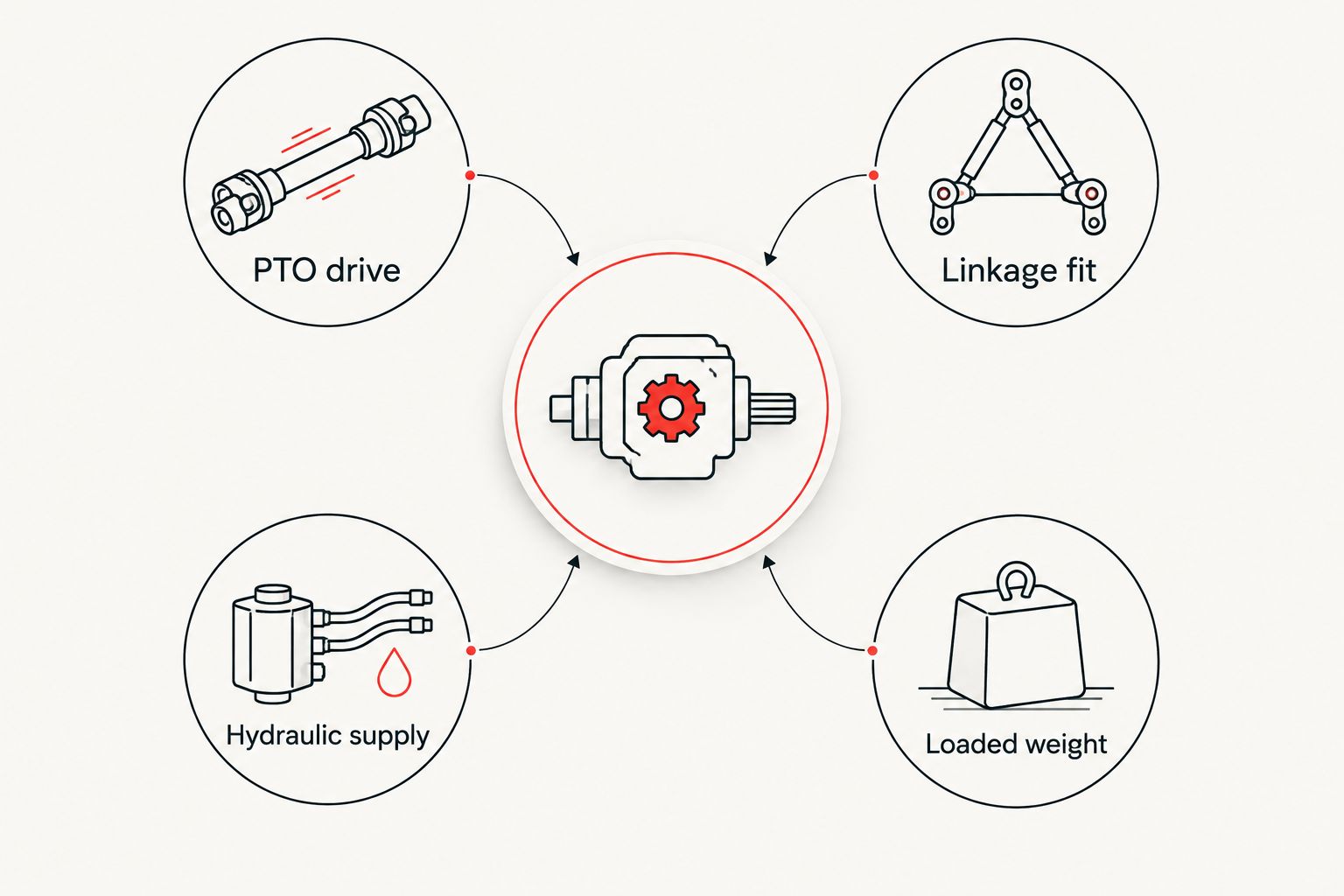
Record these checks together so the equipment supplier can assess the complete combination:
- PTO drive: confirm the specified speed and shaft fit.
- Linkage fit: check mounting dimensions and pin fit.
- Hydraulic supply: record auxiliary flow, pressure and connections.
- Loaded weight: check carrier limits and operating configuration.
Match the drive system to your working routine
Map the work manually before buying: draw where aggregate, cement, water and the placement point will sit. Then decide which machine can remain on mixing duty. If the tractor must also move materials throughout the pour, a tractor-mounted mixer creates a scheduling conflict.
A PTO mixer suits a tractor-based workflow when the tractor can stay assigned to mixing. A hydraulic mixer bucket suits work organised around a compatible loader or excavator. An electric pan mixer requires a suitable electrical supply and a workable material-loading arrangement.
Implements Direct concrete mixer options let you shortlist equipment by these working arrangements. For your 2026 shortlist, ask for the operating requirements of the exact model rather than assuming every attachment with the same drive type fits your carrier.
- Reserve the carrier for the full mixing task.
- Check how aggregate reaches the mixer.
- Establish the permitted discharge procedure.
- Confirm electrical supply for an electric mixer.
- Compare the manufacturer’s operating instructions with your site layout.
Size batches around the placement crew
Use your job schedule and crew capacity to choose batch size. Product capacity figures are useful for comparing models, but confirm whether each figure describes drum volume, loading capacity or usable concrete output. Do not treat these terms as interchangeable.
The Sierra SCM350 PTO Concrete Mixer is listed at 350L. The Sierra SCM800 PTO Concrete Mixer is listed at 800 litres and requires a 75+ HP tractor. That larger requirement rules out choosing the SCM800 solely because you want fewer batches.
A Concrete Mixer Bucket 200L Skidsteer/Excavator/Euro and a 600 L Hydraulic Pan mixer Self loading represent different loading and handling arrangements as well as different sizes. Choose the batch your crew can place consistently, within the machine’s confirmed working limits.
- Ask what the stated capacity measures.
- Confirm usable output for the intended mix.
- Match each discharge to the placement crew.
- Allow for loading and cleaning between batches.
- Check the carrier with the intended working load.
Prepare access, materials and discharge space
Walk the route before moving the mixer into position. Check gateways, turning room, overhead obstructions and the working surface. A carrier that reaches the paddock still needs a suitable place to load, mix and discharge safely.
Set up materials so operators do not repeatedly cross the machine’s working area. Keep cement protected from moisture and maintain a clean water supply. Provide a firm barrow route or another suitable transfer method where direct discharge is not possible.
Do not assume a mixer bucket or tractor attachment is approved to transport wet concrete across rough ground. Follow the manufacturer’s travel instructions and the carrier’s operating limits. Keep helpers clear of the discharge area and moving equipment.
- Inspect the complete access route.
- Select firm, level working ground.
- Separate material storage from machine movement.
- Clear the route to the placement point.
- Agree on a communication method before discharge.
- Confirm permitted travel with a loaded attachment.
Control the mix and protect the crew
Start with the specified mix and a repeatable measuring method. Follow the concrete supplier’s or designer’s instructions for materials, water addition and mixing. Adding water simply to make placement easier changes the mix and can reduce hardened concrete performance.
For structural work, establish the required testing and acceptance process before batching. A mixer’s capacity or drive system does not establish concrete strength. Keep records that connect the materials and batches to the work completed.
Wet concrete can cause chemical burns, and cement dust requires exposure control. Guard moving parts and isolate the machine before clearing blockages or inspecting inside it. Never reach into an operating mixer, even when a blockage appears easy to remove.
- Measure materials using a consistent method.
- Follow the specified water addition.
- Record batches and any required test results.
- Wear suitable eye, skin and respiratory protection.
- Keep PTO guards and other guarding in place.
- Stop and isolate before clearing or servicing.
Plan cleaning and ownership before purchase
Use a simple worksheet to compare ownership with hire or delivered concrete. Include attachment changes, material handling, cleaning, storage and the time your carrier remains committed to mixing. These tasks belong in the decision even when the pour itself is short.
For your 2026 purchase decision, request the maintenance instructions and identify wear components before ordering. Check how the mixer is supported during servicing and how you can access the mixing area safely. Ease of cleaning deserves the same attention as nominal capacity.
Prepare a contained washout area before mixing starts. Keep cement washwater out of drains and waterways, and follow local disposal requirements. Hardened residue is harder to remove and can interfere with normal operation.
- Compare ownership, hire and concrete delivery.
- Read the cleaning and lubrication instructions.
- Identify replaceable wear components.
- Plan safe access for inspection and servicing.
- Establish contained washout and disposal.
- Provide suitable storage between jobs.
Compare concrete mixing options for rural building
There is no single best mixer across every rural building task. The best option matches your carrier, working location and required placement continuity. Implements Direct’s listed capacities help narrow the comparison; confirm working output and compatibility before selecting a model.
| Option | Best for | Practical advantage | Key limitation |
|---|---|---|---|
| Sierra SCM350 PTO Concrete Mixer | Tractor-based farm construction with suitable batch requirements | Tractor-mounted PTO mixing; listed at 350L | Requires confirmed tractor, linkage and PTO compatibility; working output needs checking |
| Sierra SCM800 PTO Concrete Mixer | Larger tractor-based construction work | Listed at 800 litres | Requires a 75+ HP tractor; lift capacity, stability and PTO fit still need assessment |
| Concrete Mixer Bucket 200L Skidsteer/Excavator/Euro | Loader-based work with a compatible mounting arrangement | Listed at 200L; description specifies a standard skid steer attachment plate | Do not assume every mounting named in the title is supplied or fits your carrier |
| 600 L Hydraulic Pan mixer Self loading | Hydraulic mixing where the self-loading arrangement suits the site | Description specifies 600L mixing capacity and self-loading | Hydraulic and mounting requirements must be confirmed; nominal size does not establish carrier suitability |
| Hired portable mixer | Occasional jobs without a dedicated carrier attachment | Avoids storing an owned mixer between jobs | Requires a suitable drive supply, collection arrangements and manual material handling |
| Delivered ready-mix concrete | Planned pours with suitable delivery access | Removes on-site batching from the crew’s work | Requires coordinated delivery, access and placement; does not solve finishing or site preparation |
For an attachment purchase, use the comparison to decide which working arrangement fits first. Then check the exact model documentation. The following equipment provides concrete starting points for that discussion, not a substitute for a carrier compatibility check.


Common mistakes rural builders make
Avoid these errors when planning your 2026 mixer purchase. Each one creates a mismatch between the equipment and the actual building task.
- Buying litres before checking the carrier. A larger mixer brings a larger working-load assessment. Confirm mounting, drive requirements and permissible loading before choosing capacity.
- Allocating the same tractor to mixing and material supply. If the tractor must alternate between a mixer and pallet forks, batching stops during changeovers. Plan a separate handling method or sequence materials before the pour.
- Treating a bucket title as a fitment guarantee. Skid steer, excavator and Euro mounting arrangements are not interchangeable. Confirm the supplied attachment interface and hydraulic connections for the exact machine.
- Using repeated small batches without a placement plan. Structural pours need agreed sequencing and any construction joints must follow the project requirements. Do not let the mixer’s batch size decide where a slab stops.
- Leaving washout until after placement. Cleaning needs water, containment and safe access. Prepare these before the first batch rather than washing cement residue towards a farm drain.
FAQ
What is the best concrete mixer for rural builders?
The best concrete mixer for rural builders is the one that matches the carrier, usable batch requirement and placement plan. Choose between PTO, hydraulic and portable mixing only after checking how materials and concrete will move around the site.
Is a PTO concrete mixer better than a hydraulic mixer bucket?
A PTO concrete mixer is better suited to a tractor-based workflow, while a hydraulic mixer bucket suits a compatible loader-based workflow. Neither drive system removes the need to check mounting, loaded weight and safe discharge.
Will the Sierra SCM350 PTO Concrete Mixer fit my compact tractor?
A fit cannot be established from the 350L capacity alone. Confirm the Sierra SCM350 PTO Concrete Mixer’s linkage, PTO and loading requirements against your tractor’s manual before purchase.
What tractor does the Sierra SCM800 PTO Concrete Mixer need?
The Sierra SCM800 PTO Concrete Mixer requires a 75+ HP tractor according to its product description. You must also confirm PTO compatibility, mounting, lift capacity and stability for the intended working load.
Does a mixer’s listed capacity equal its concrete output?
A listed capacity does not automatically establish usable concrete output. Ask whether the figure refers to drum volume, loading capacity or mixing capacity, and obtain the operating limit for the exact model.
Can I use an on-site mixer for structural concrete?
On-site mixing must produce concrete that meets the structural project specification. Follow the designer’s requirements for materials, batching, placement and testing; the mixer itself does not certify concrete strength.
Should I hire a mixer or buy a tractor attachment?
Hire suits occasional work when you do not need to retain dedicated mixing equipment. Buying suits a recurring workflow only when carrier compatibility, handling, cleaning and storage are resolved.
What should I ask Implements Direct before choosing a concrete mixer?
Ask Implements Direct to confirm the exact mixer’s drive requirements, mounting arrangement, usable output and working-load information. Provide your carrier model and specifications so the equipment discussion starts with fit rather than capacity.
One last thing
Plan the final transfer before choosing the mixer. A machine that mixes beside the aggregate pile still leaves you with a handling task if it cannot discharge where the concrete is needed.
For your next 2026 pour, walk from material storage to the placement point with the crew. Identify who controls discharge, who moves concrete and where each person stands. That short site check exposes equipment mismatches before they become a pour-day problem.