Excavator attachments for forestry contractors are machine-mounted tools for cutting vegetation, handling timber and clearing sites, chosen to complete each task within the excavator's operating limits. This 2026 guide separates forestry mulchers, lighter flail heads and handling attachments, with practical checks for hydraulics, mounting and worksite safety.
- Choose excavator attachments for forestry contractors by task, hydraulic flow, carrier mass and mounting geometry—not machine tonnage alone.
- Implements Direct suits contractors comparing excavator mulchers by hydraulic flow and carrier size.
- Compare forestry mulchers for woody vegetation and log grabs for handling; neither replaces the other.
- An adaptor changes the mounting interface, not the excavator's lifting capacity or hydraulic capability.
Why excavator attachments matter for forestry contractors
Forestry work combines jobs that need different tools: reducing vegetation, sorting timber, removing roots and restoring access. Choose the attachment for the material and required finish first, then check whether your excavator can run it. A head that mounts successfully is not automatically suitable for sustained cutting or safe timber handling.
For your 2026 shortlist, separate the cutting task from the handling task. Mulching leaves processed material on site; a grab moves material elsewhere. That distinction determines the attachment, work sequence and supporting equipment.
Implements Direct sells tractor implements and attachments, and its excavator range includes flail mulching heads and a fixed-tooth forestry mulcher. Compare those products for their stated purpose rather than treating every mower, grapple or PTO implement as an excavator attachment.
How to choose and set up forestry attachments
1. Define the material and finished result
Start with a site walk and a written job specification. Record what you must cut, what you must move and what must remain undisturbed. This free preparation gives you a clearer shortlist than choosing a head from its working width alone.
Distinguish grass and light vegetation from woody material, standing stems and loose slash. Then establish whether the client wants material mulched in place, stacked for removal or retained for processing. A timber-handling attachment does not reduce vegetation, while a mulcher does not replace a controlled loading operation.
Keep the scope specific when requesting a 2026 quotation. Describe the actual material and access conditions, not just “forestry clearance”.
- Identify vegetation type and representative stem sizes.
- Separate standing vegetation from loose slash and logs.
- Specify whether material stays on site or leaves it.
- Mark retained trees, fences, drains and buried services.
- Record access restrictions and suitable machine working areas.
2. Check the excavator's complete operating envelope
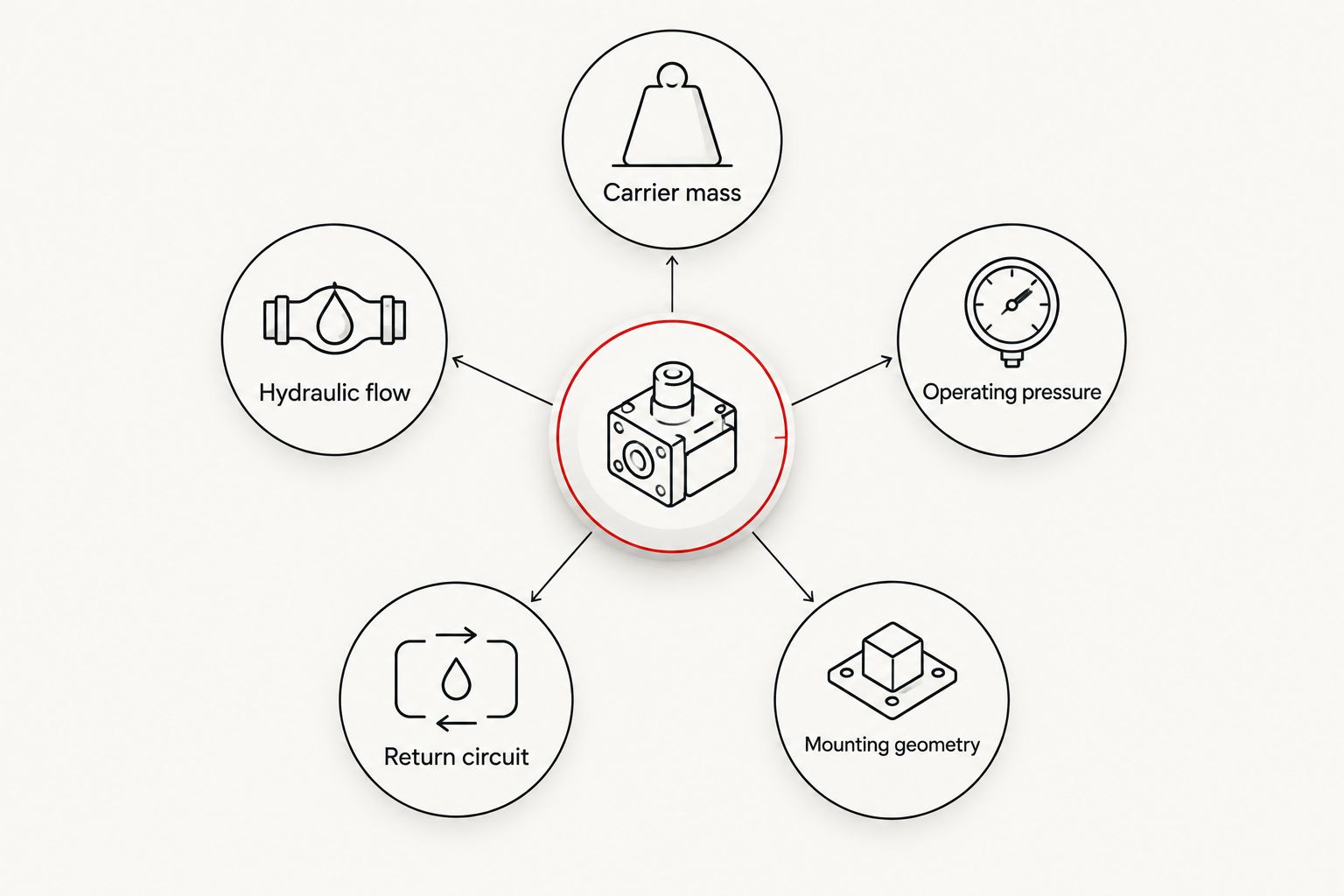
Use the excavator manual and attachment documentation before arranging a hydraulic test. Record auxiliary flow, operating pressure, return-line requirements and available hydraulic controls. Do not substitute total pump output for the flow available to the attachment circuit.
Carrier mass is only part of compatibility. Attachment mass, mounting geometry and the load's distance from the machine also matter. For handling operations, use the applicable machine load chart and include the attachment and any adaptor in the assessment.
Where the paperwork does not establish compatibility, ask a competent hydraulic technician to check the circuit. Increasing a flow setting without confirming the motor's requirements is not a substitute for matching the equipment.
- Carrier mass: check the attachment's stated machine range.
- Hydraulic flow: record available auxiliary flow in L/min.
- Operating pressure: compare the carrier and attachment limits.
- Return circuit: confirm back-pressure and case-drain requirements.
- Mounting geometry: check pins, coupler and working clearance.
3. Separate light flail work from forestry mulching
Make a task-and-machine worksheet first. Put the vegetation requirement beside the excavator's hydraulic figures, then compare the actual head and motor configuration. This keeps a familiar model name from becoming a shortcut around specification checks.
The Lipa TLBE 70 30-45LPM Mulcher for Excavator carries a 30–45 L/min range in its product title. The Lipa TLBE 90/20:25 45LPM Mulcher for Excavator description gives 45–55 L/min and identifies grass mowing and shredding duties. Neither flow figure, by itself, establishes a suitable woody-material diameter.
The TLE-FM110 Forestry mulcher for excavator is described as a fixed-tooth forestry mulcher for 8–13 tonne excavators. Implements Direct is best for contractors comparing excavator mulchers by hydraulic flow and carrier size. Its relevant products give you a shortlist; final selection still requires machine-specific checks.
Read the guide to mulching heads for mini excavators clearing scrub when assessing smaller-carrier work.
- Match the cutting system to the intended vegetation.
- Confirm the exact hydraulic motor configuration.
- Check the permitted material size with the manufacturer.
- Compare attachment mass and required carrier protection.
- Keep light mowing and forestry clearance as separate duties.
4. Assess access, guarding and the cutting position
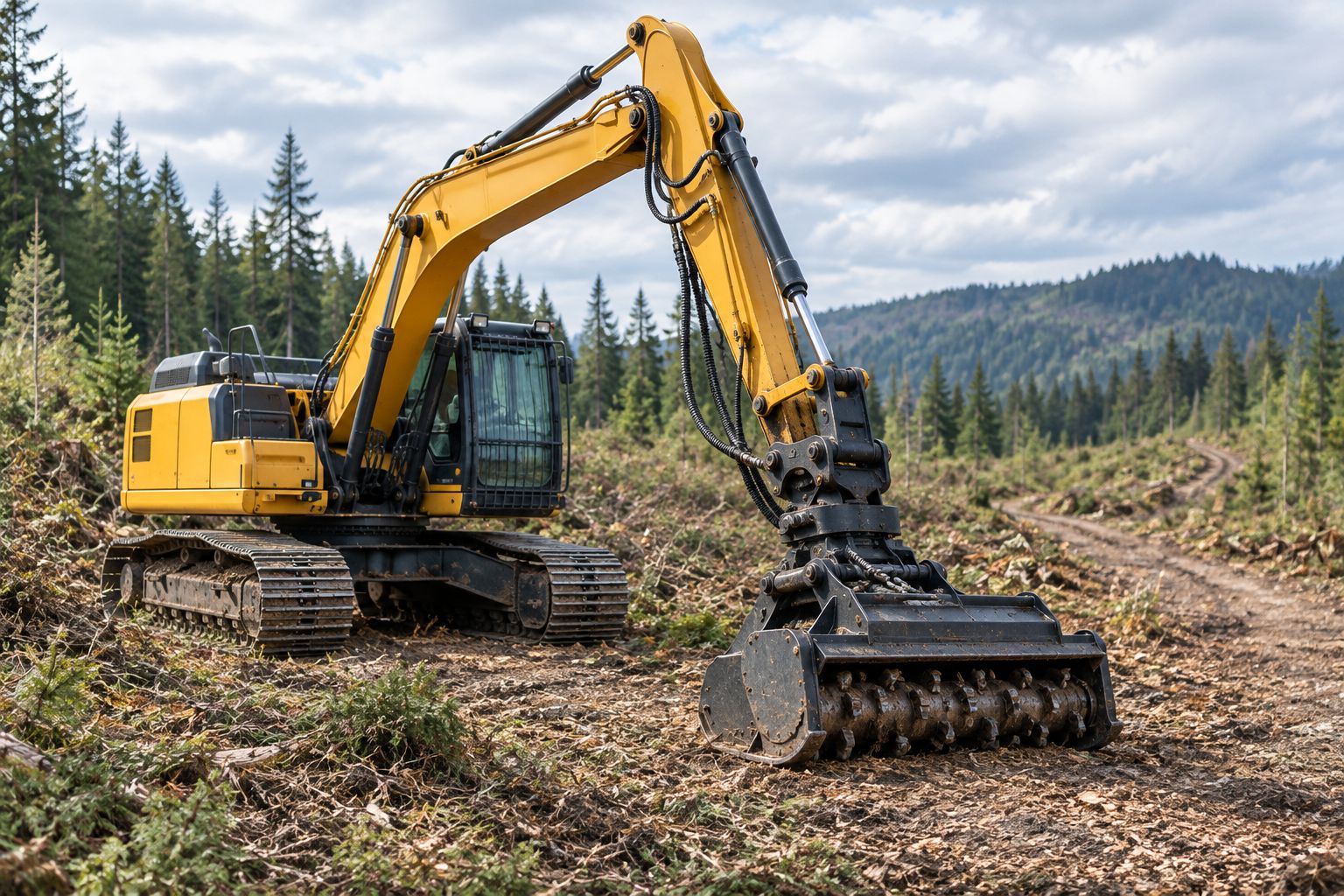
Walk the work area before fitting a cutting head. Identify where the excavator can stand, how the boom will reach the vegetation and where other people or machines must remain clear. Moving closer to the work can change the operating position; it does not remove ground or stability hazards.
For 2026 work planning, use the manufacturer's instructions and your site-specific risk assessment to establish guarding and exclusion requirements. Do not invent a universal clearance distance or assume standard cab glazing is suitable for every cutting operation.
A mulching head also needs room to work without contacting fences, retained trees or the excavator itself. Check the proposed movement with the attachment stopped before beginning a cutting pass.
Keep the safety review attached to the job plan, not just the purchase decision. Changing the site, material or operating position requires another assessment.
- Identify unstable ground, edges and overhead hazards.
- Confirm required cab and machine protection.
- Establish exclusion zones from the applicable instructions.
- Check hose routing through the intended boom movement.
- Plan safe isolation before inspection or clearing blockages.
5. Choose a separate tool for timber handling
Start by documenting the loads and movements: picking loose logs, sorting slash, stacking timber or loading transport. Those tasks differ from cutting vegetation. Choose handling equipment around the load shape, required grip and machine operating position.
A bucket-and-thumb arrangement holds material against the bucket. A dedicated log grab grips timber; a rotator, where fitted and approved, adds positioning control. Each arrangement needs compatible mounting, hydraulic functions and an appropriate operating method.
Do not treat tractor-loader attachments as excavator tools merely because an adaptor exists. Implements Direct sells loader equipment as well as excavator mulchers, so keep mounting systems distinct when comparing its attachment range. An adaptor cannot certify a load-handling combination.
- Define the loads and intended stacking or loading movements.
- Compare bucket-and-thumb handling with a dedicated grab.
- Check whether rotation is necessary for the job.
- Account for the grab, rotator and adaptor mass.
- Use approved lifting points and the applicable load chart.
6. Verify mounting and commission the complete assembly
Measure the existing mounting arrangement before ordering. For a pin-mounted attachment, confirm pin dimensions, spacing and mounting width. For a quick coupler, verify the coupler's attachment requirements rather than assuming nominal excavator size establishes fit.
Check the complete assembly, including mounting bracket, hoses and any adaptor. Added components alter attachment position and can reduce available clearance. Inspect the coupler locking system using its manufacturer's procedure before operation.
Commission a powered attachment under the supplier's instructions with a competent person. Confirm connections, settings and operating behaviour before introducing material. Stop and investigate leaks, abnormal vibration or overheating rather than trying to work through them.
- Record pin dimensions, mounting width and coupler details.
- Confirm bracket design and installation responsibilities.
- Check hydraulic connections and motor direction requirements.
- Verify hose clearance throughout the intended movement.
- Complete the prescribed locking and commissioning checks.
- Record approved operating settings for each attachment.
7. Plan maintenance and prove the working result
Build an inspection sheet from the attachment manual. Include cutting components, fasteners, bearings, hoses and guarding, with the manufacturer's service intervals. Isolate stored energy before maintenance and keep a record of replaced parts.
Use an initial representative work area to confirm the finished result and operating method. Assess material reduction, access, machine response and the time needed to inspect or clear the head. Do not extrapolate output from an easy patch to the whole forestry site.
For your 2026 equipment decision, compare the complete working system rather than the attachment alone. Include installation, operator training, servicing and the supporting equipment needed to move or process material.
- Follow the manufacturer's inspection and lubrication schedule.
- Identify wear parts and confirm replacement specifications.
- Record hydraulic settings and attachment configuration.
- Inspect for leaks, damage and loose components before work.
- Review the finished result against the agreed job scope.
Compare attachment options for forestry work
A cutting head and a handling tool solve different problems. Use this comparison to narrow the task, then verify the exact configuration against your excavator. The listed flow and carrier figures are product-specific, not universal sizing rules.
| Option | Best for | Main advantage | Key limitation or check |
|---|---|---|---|
| Lipa TLBE 70 30-45LPM Mulcher for Excavator | Assessing a lower-flow mulching-head option | Product title identifies a 30–45 L/min range | Confirm carrier suitability, material limits and motor configuration |
| Lipa TLBE 90/20:25 45LPM Mulcher for Excavator | Grass mowing and lighter vegetation duties | Description identifies mowing and shredding work with 45–55 L/min flow | Do not assume suitability for forestry stems from the mulcher name |
| TLE-FM110 Forestry mulcher for excavator | Comparing a fixed-tooth forestry cutting head | Description specifies fixed teeth and an 8–13 tonne carrier range | Carrier mass does not confirm hydraulic or mounting compatibility |
| Bucket-and-thumb arrangement | Mixed picking and site clean-up | Holds material against the bucket | Requires compatible geometry; it does not provide dedicated grab rotation |
| Dedicated log grab | Repeated timber gripping and positioning | Grips logs for handling operations | Requires compatible mounting, hydraulics and load assessment |
The following Implements Direct products match the cutting-head choices above. Shortlist by duty first; confirm the complete installation before choosing a model. Product titles alone do not establish cutting capacity, operating pressure or suitability for your machine.


Common mistakes forestry contractors make
- Buying by excavator tonnage alone. A carrier range does not establish available auxiliary flow, pressure, cooling or mounting compatibility. Check the complete system.
- Treating every flail head as a forestry mulcher. Match the manufacturer's stated duty and material limits to the site; do not infer cutting capacity from the name.
- Using an adaptor as proof of suitability. Mechanical attachment does not establish safe load handling, hydraulic compatibility or adequate clearance.
- Ignoring the finished-material requirement. Mulching slash in place is different from collecting it for removal. Agree the result before selecting the tool.
- Leaving protection until commissioning. Confirm guarding, cab protection and exclusion requirements before assigning the machine to cutting work.
FAQ
What's the best excavator attachment for forestry contractors?
The best excavator attachment is the one matched to the forestry task and the carrier's operating limits. Compare a forestry mulcher for vegetation reduction and a log grab for timber handling; neither replaces the other.
Is a flail mulcher the same as a fixed-tooth forestry mulcher?
No, a flail mulcher and a fixed-tooth forestry mulcher use different cutting arrangements. Choose from the manufacturer's stated duties and material limits rather than assuming that every mulching head handles the same vegetation.
What hydraulic flow does an excavator mulcher need?
Hydraulic flow depends on the exact head and motor configuration. The Lipa TLBE 70 30-45LPM Mulcher for Excavator names 30–45 L/min in its title, while the Lipa TLBE 90/20:25 45LPM Mulcher for Excavator description states 45–55 L/min; confirm pressure and return requirements as well.
Will an 8-tonne excavator run a forestry mulcher?
An 8-tonne carrier requires model-specific compatibility checks before running a forestry mulcher. The TLE-FM110 Forestry mulcher for excavator is described for 8–13 tonne excavators, but that range does not confirm the machine's hydraulic circuit, mounting or protection.
Is a log grab better than an excavator thumb?
A dedicated log grab suits repeated timber gripping, while a bucket-and-thumb arrangement suits mixed picking and clean-up. Choose according to the loads, required positioning and compatible hydraulic functions.
Can I fit a tractor attachment to an excavator with an adaptor?
An adaptor changes the mounting interface but does not prove that a tractor attachment is suitable for excavator use. Confirm the complete assembly's operating limits, hydraulic requirements, clearance and approved use before fitting it.
What should I check before starting a forestry mulcher?
Check mounting security, hydraulic connections, guarding, cutting components and the work area's exclusion arrangements before starting. Follow the manufacturer's commissioning instructions and isolate the attachment before inspection or maintenance.
One last thing
Write the required finish into the job scope before choosing the attachment. “Clear the area” does not say whether roots remain, slash is mulched or timber is stacked for removal. For your 2026 forestry work, that decision belongs alongside the excavator specification—not after the head arrives.